
Service, Sacrifice and Stone
A Journey to the Milan Cortina Paralympics

As a reporter/editor for a rural newspaper, I have met many interesting people who share their stories with me. It’s the best part of being a “journalist” and feature stories are my favorite because they focus on real people, sometimes doing extraordinary things. Some of those stories stay with me and this is one.
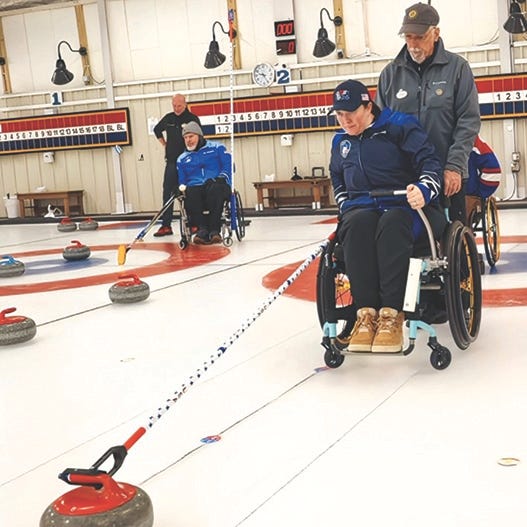
Meet Katie Boumans Verderber, who is heading to Italy as a member of Team USA in Wheelchair Curling at the 2026 Winter Paralympic Games in Cortina d’Ampezzo, Italy. Currently training in Wisconsin, she took time to speak with me on the phone.
“I am so excited for this opportunity,” Verderber told me. “Curling is a passion I care deeply about. It’s a sport for everybody.”
It has taken dedication, a high level of commitment and a lot of Montana grit for this young U.S. Army veteran, paralyzed since 2023 after being injured during her deployment in Afghanistan. A native Montanan who grew up in Valier, a small town in north central
Montana, Verderber joins team members Matthew Thums and Dan Rose of Wisconsin, Oyuna Uranchimeg of Minnesota and Sean O’Neill from Massachusetts. (You can catch the Olympics and Paralympics NBC and the Peacock channel.)
After graduating from the University of Montana, Verderber pursued her Juris Doctor degree at Syracuse University’s College of Law. As she neared graduation, the prospective job market was oversaturated with lawyers, making it difficult for a licensed attorney to find a job. Katie had planned to return home and intern with the Pondera County district attorney, but that changed when Army recruiters came to the Syracuse campus and she attended a JAG recruiting session.
“The Army was offering four years of a guaranteed job. I didn’t think I would get in because the acceptance rate was only 15-25%. So many lawyers were applying. It was competitive.”
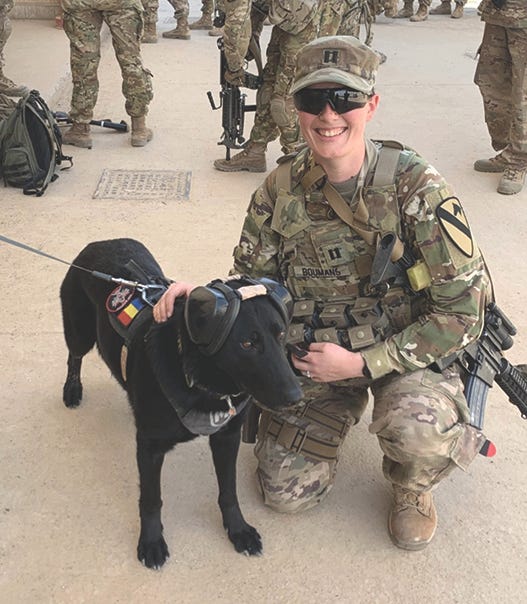
Verderber was accepted and commissioned as a Judge Advocate General officer. She deployed to Afghanistan in 2019 as advisor to senior leaders on targeting decisions, requiring her to be on the ground. During a mission Verderber sustained an injury that compressed her spine. She underwent surgery that included replacing compressed discs. The surgery did not go well and over time the discs began to migrate. Still able to function, although in a lot of pain, Verderber transferred to Ft. Hood where she served as a defense attorney.
“Being a defense attorney for over 140 soldiers was the most rewarding part of my army career.”
Any possibility for corrective spine surgery was delayed due to Covid.
“Care shut down during Covid,” said Katie. “I continued to work. I still had courts martial every week.”
In 2021 she moved to Fort Gordon, Georgia and underwent two more unsuccessful surgeries. By the fall of 2022 it was determined Verderber was no longer medically deployable and was officially retired a year later in Sept. 2023. She moved back to Montana and began working for the Montana Department of Justice.
In June 2023, Katie married her life partner, Danielle Verderber, at the top of Big Mountain in Whitefish, MT. Her health deteriorated and she began to lose function and mobility. Six months later she awoke one morning, her legs paralyzed. She was rushed to the E.R. and into surgery. Katie was transferred to the VA Spinal Cord Injury Unit in Seattle for rehabilitation. Her hopes for improvement vanished when Katie learned the gravity of her injury. Blood and oxygen were not getting to her lower spine.
“I had permanent paralysis from my bellybutton down.”
She was told she would be in a wheelchair.
“A lot of vets there were alone. I was fortunate that I was never alone. Danielle sat with me. My mom flew in and sat with me and went to every therapy session. It was that support that kept me going.”
There were days Katie didn’t want to go to a therapy session, but she said her family forced her to go. High school friends from Valier and college classmates flew out to surprise her.
“I always had ongoing friends and family there for me. There’s strength in family and friends. They felt I had something more important to do and they didn’t give up on me.”
In April 2024 Katie attended a VA-sponsored adaptive sports clinic for disabled veterans in Aspen, CO. Her plan was to get back on the slopes by taking the adaptive skiing course.
“The VA provided all the equipment, but to qualify I had to check all the boxes.”
A recreational therapist had to observe her in Aspen. Katie was required to sign up for two adaptive sports, not just skiing. Why curling?
“I was forced into it,” Katie laughed.
Other than skiing, her choices were fishing, snowmobiling, rock climbing or curling. Fishing and snowmobiling didn’t appeal to her.
“I couldn’t rock climb when I was fully able,” Katie said. “I knew there was no way I could rock climb now.”
That left curling and Katie fell in love with it. Wheelchair curling requires precision, strategy and strength to slide 20 kilograms (44.09 pounds) of granite, the “stone,” to hit a target. It’s a mixed team sport open to men and women with physical disabilities in their legs. Players can throw the stone alone or with a teammate holding the wheelchair steady. The athletes can use an extender to add speed. Each player throws two stones for a total of eight stones per team. The stone closest to the center of a circular target marked on the ice scores a point.
While in Aspen, an unexpected meeting would alter Verderber’s life.
“I had only thrown a few stones when I was approached by an old coach who was involved with the Paralympic team,” she said. “He asked me if I was interested in doing this. I gave him my number but didn’t expect him to call. Back in Montana I got a phone call to come to Denver for the first identification camp. It was my first time traveling alone in a wheelchair.”
She loved the camp.
“I have always been competitive, and I transitioned that into being hyper focused. With curling, I found a new thing to be hyper focused about.”
Since the identification camp, Katie has traveled twice a month to curl.
“There is no dedicated curling ice in Montana, so I have to travel.”
After competing in 26 games she could have a spot on the Paralympics team. In June 2025 the USA Curling program decided to take a new team to Italy. Katie flew to Scotland to be medically classified and was then invited to selection camp in August. She has since attended several selection camps and competitions that involved extensive traveling. The final selection camp was in Minnesota, the headquarters of USA Curling. Twelve athletes attended. Katie was one of the five chosen to go to the 2026 Milano Cortina paralympic games. The fast pace didn’t allow her to grieve.
“For me, it was part of my healing. People think that once you heal, you move on.” She still has good days and bad days. “The biggest takeaway from all this is that I hope someone else can hear my story and realize there’s good and bad. I still grieve. I still get angry. It’s okay to be both.”
Now, two years later, Katie is preparing for the 2026 Paralympics as a member of Team USA in wheelchair curling. On a typical training day, now in Wisconsin, the team is up at 5:30 a.m. and is on the ice at 7 a.m. for the pregame warm up. They compete at 9 a.m. for the first game, with a second game later in the day. They are replicating the schedule in Italy, where most days they will have two draws. The team returns to the hotel at 10 p.m.
“We do things to keep engaged to replicate the late night draws we will have in Italy. I am getting used to the loss of sleep,” commented Katie.
Their first game will be March 7 and the team will continue to compete until the final games on March 14. The team leaves Feb. 24 to train in Minnesota, then flies to Italy on the 28th, arriving Feb. 29. This allows them to adjust to the time difference.
In addition to the intense training schedule, Katie continues to practice law full time as a litigator in private practice at Silverman Law Office in Helena.
“I am fortunate to be able to work remotely,” she said. The attorneys at Silverman Law Office have been very supportive. “They are allowing me to chase this crazy dream.”
Katie carries her full weight with the firm. She plans to get all her billable hours in, working right up until time to leave for Italy.
“The U.S. is one of the few countries that does not pay for its Olympic athletes. I need to keep working to afford to go. It is extremely demanding.”
What is Katie most looking forward to at the Paralympics?
“Being there with the team. The best thing to come out of this experience is the friends I have made and getting to be around other wheelchair users. One thing that is unique to this sport is community.”
This will also be the first time at the Paralympics for two other team members. The U.S. have never taken a medal in Paralympics curling. Katie said she is looking forward to the possibility of a first USA Curling medal and getting to support her country, wearing the U.S. flag again in a different capacity. Danielle, Roy and Kay Weikum, Katie’s mom and stepdad, are flying to Italy to watch.
“This will be the first time my mom will see me on the ice. I have an army behind me,” said Katie. “Danielle, my mom and friends, it’s their moment too.”
What’s next for Katie Verderber?
“I do not plan on hanging up my curling stick. I plan on remaining on the team.”
Next fall she will fly to Finland to “medal” and get a spot to compete at the 2027 World Games.
“We are building a program, and I need to continue to earn and keep a spot on the team. I don’t want to lose any ground.”